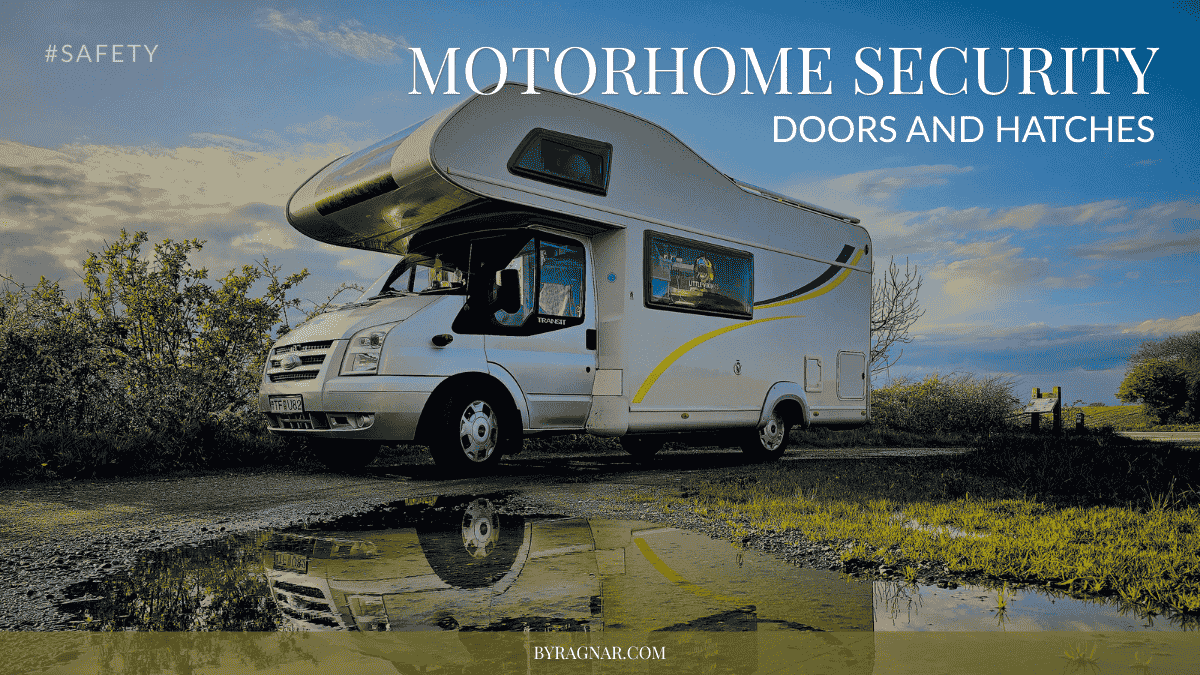
Once windows become a little harder to deal with, attention often shifts elsewhere. Thieves then look at the doors – and especially the hatches that many people completely overlook.
This isn’t about being suspicious or fearful. It’s about understanding how others think and staying one step ahead. Doors and hatches are the next logical step in this security series, and in many cases the situation can be improved with small, cost-effective measures.
Why Doors and Hatches Matter
Doors in motorhomes are generally lighter than those in traditional houses. The same applies to hatches – they are often made of plastic, fitted with simple locks, and positioned where there is little foot traffic or direct visibility.
A thief doesn’t always need to get into the living area.
Sometimes it’s enough to access a storage compartment.
Storage areas often contain:
- tools
- electrical equipment
- bicycles
- gas or battery systems
- and sometimes even keys that have been left behind

The Most Common Doors – and Their Weak Points
1. The Main Entry Door
The most common entry point, and often fitted with:
- a single main lock
- a lightweight aluminium or plastic frame
- weak fixings in the door leaf
Weak points:
The lock itself, the handle, and the frame.
2. Cab Doors
Especially in older vehicles:
- simpler locking mechanisms
- windows with rubber seals that can be cut
- fewer additional security measures
These doors are often overlooked – but are a very common entry point.
Hatches – The Forgotten Link
Hatches are often:
- made from thin plastic
- fitted with simple twist locks
- positioned on sides that are poorly visible
Hatches give access to:
- storage compartments
- gas systems
- batteries
- water tanks
They are often the quietest way in – which makes them attractive to thieves.

What Can We Do? – Cost-Effective Solutions That Work
The key question is this:
How do we strengthen doors and hatches without ruining the joy of travelling or emptying our wallets?
A) Cheap and Simple – Anyone Can Do This
✔ Good routines – walk around the vehicle before going to bed or leaving it unattended.
✔ Check locks regularly – wear, cracks and loose screws all matter.
✔ Never leave keys in hatches – a surprisingly common mistake.
✔ Motion sensor or light near doors/hatches – simple but effective.
✔ Chain lock or simple internal door lock – especially overnight.
👉 A simple chain lock once saved us from a break-in.
B) Mid-Range Cost – High Impact
✔ Additional door locks – doubling resistance makes a difference.
✔ Frame reinforcement – better screws and fixings.
✔ Improved hatch locks – replacing the weakest plastic locks.
✔ Simple locks on storage hatches – make opening slower and noisier.
C) Stronger Solutions
✔ Internal door bar – particularly for the main entry door.
✔ Alarm on doors and hatches – sounds if something is opened illegally.
✔ Specialised motorhome security locks – more expensive, but very effective.
👉 We installed additional locks from Fiamma on both hatches and the door. These locks can be purchased on Amazon.
Think Like a Thief – One Last Time Today
If you were a thief:
- Which door is least visible?
- Which hatch looks weakest?
- What can be opened quietly?
If something takes too long…
the thief often moves on.
Thieves hate hassle.
We just need to create a little of it.

Security vs Emergency Exit
A very important point.
Doors and hatches are not just potential entry points – they can also be escape routes in an emergency. Any solution should:
- be easy to open from the inside
- but harder to open from the outside
We never block an escape route – even if the intention is good.
A Bit of Experience – and a Gentle Disclaimer
I’m not a security expert – just someone who has gathered a bit of experience while travelling and wants to share what has worked well for us. If you have your own stories or solutions, feel free to share them in the comments. We’re learning this together.
Our motorhome is fairly old, and when we started travelling in it, we quickly began thinking about how to improve the security of the cab doors. One solution many people use – and which initially appealed to us – involves special cables or straps that hook onto the door handles and secure into the seatbelt buckle.
However, our doors didn’t have suitable handles, so we chose a different approach. This solution is admittedly controversial, but it has worked well for us. We bought a chain and loops, fixed the loops to the doors, and connect the chain between the doors when the vehicle is stationary. This makes it much harder to open the doors from the outside.
Very important: the chain must never be connected while driving. This solution is only used when the vehicle is stationary.
It’s also worth mentioning that in older vehicles it can be relatively easy for thieves to use a screwdriver, insert it into the lock mechanism and force the door open. For this reason, some motorhome owners install protective covers over the lock cylinders to prevent access with tools. Fiamma locks, for example, have been used for this purpose and can be a simple and effective upgrade.
Final Thoughts – The Same Red Thread
The goal isn’t to lock ourselves in.
The goal is to be just a little harder to break into than the next vehicle.
One step ahead.
One door at a time.
One hatch at a time.
Frequently Asked Questions (Q&A)
1. Are motorhome doors generally weaker than car doors?
Yes. They are often lighter and designed with weight and comfort in mind rather than resistance.
2. Why are hatches popular targets for thieves?
They are often poorly visible, fitted with simple locks, and can be opened quietly.
3. Do additional locks really help?
Yes. They increase time, noise and risk – all things thieves try to avoid.
4. Do I need to secure every hatch?
Not necessarily. Start with the weakest ones or those that contain valuables.
5. Can alarm systems be too sensitive?
Yes, if poorly adjusted. Simple systems with sensible settings work best.
6. Can doors be strengthened without blocking emergency exits?
Yes. Solutions should always be easy to open from the inside.
7. What’s the most important piece of advice?
Routine. Walking around the vehicle, locking everything, and staying aware makes the biggest difference.